



ABOVE: The long narrow (lanceolate) leaves of a juvenile Ficus binnendijkii from Kuala Belalong in Temburong, Brunei. Many species of plants in the Moraceae family (breadfruit/figs) produce different shaped leaves in juvenile and adult plants. This is especially common with the root climbing figs in Section Rhizocladus.
However in Section Conosycea (strangling figs) only two species are known to produce dimorphic leaves, F. binnendijkii and F. maclellandii. In both cases the juvenile leaves are long and thin (lanceolate) and the adult leaves are shorter and and more rounded. Berg (2011) Leaf dimorphy in F. binnendijkii and F. maclellandii.
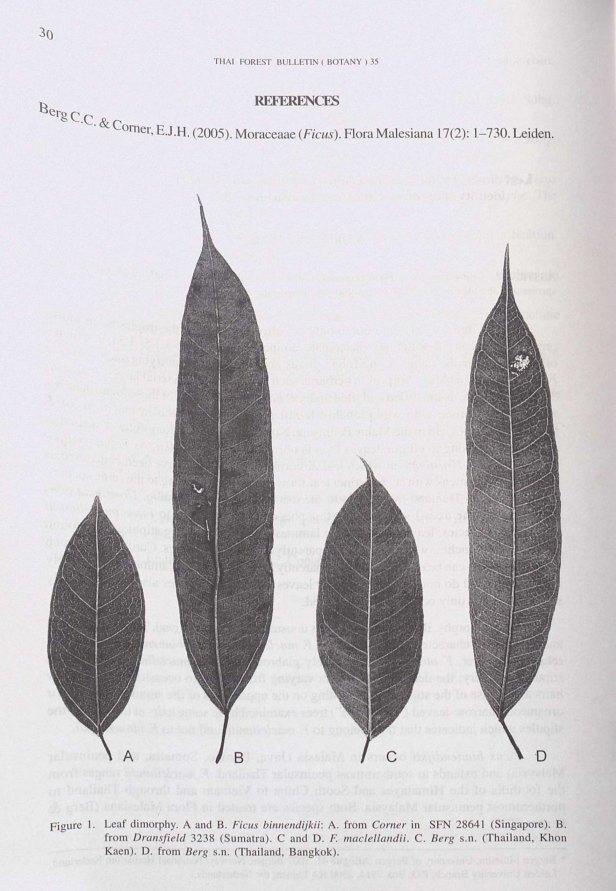

Note that Berg’s leaf illustrations clearly show strong basal veins in both the F. binnendijkii leaves which are absent from the both the F. maclellandi leaves.


