



North Borneo Gibbon Hylobates funereus eating ripe yellow/green Ficus variegata figs at Tabin Wildlife Reserve in E. Sabah. Note that F. variegata figs may ripen any colour from green to bright red depending on the individual tree.
Studies show that the population of gibbons and figs is closely related both within and outside Borneo. The higher the density of figs the higher the density of gibbons.


After the Langurs (8 species) the 4 species of Borneo gibbons are the most common large fruit eating primate in undisturbed virgin forest.
Gibbons live in small family groups normally two adults and one to two juveniles. Adults patrol the boundaries of their forest patch daily and defend their territory with loud early morning calls. Note that the gibbon density figures below refer to individuals per km 2 based on the number of territories and the average number of individuals per family.
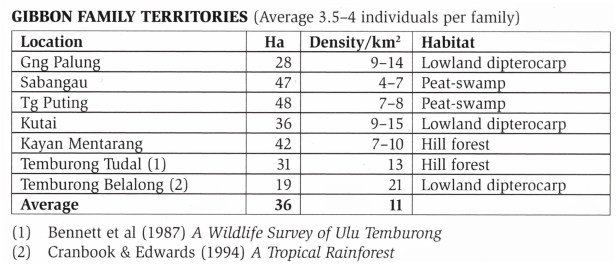


The relationship between fig density and gibbon density was confirmed by studies carried out at Gunung Palung in SW Kalimantan by Marshall and Leighton (2006).


Cline et al (2017) also at Gunung Palung compared the diet of gibbons and Red Langurs Presbytis rubicunda between 2007- 2013. Their research showed that the gibbon population was limited by the availability of their fall back foods mainly figs whilst the population of langurs was limited by the availability of langur preferred food – unripe fruit seeds.
Overall 27% of gibbon diet came from figs whilst only 14 % of langur diet was figs. During lean seasons gibbons eat figs whereas langurs eat leaves which are always available.
Marshall & Leighton (2006) Gibbon & fig density correlated Gng Palung
Clink et al (2017) Diet of gibbon and langur at Gng Palung compared
Mather (1992) Phd Field Study of Hybrid Gibbons Kalimantan Chap 5 only