ABOVE A cross section through a male Ficus virescens fig fruit. Note the bright red male anthers surrounding the ostiole. The egg shaped objects are the gall flowers which contain the developing larvae of fig wasps. When these fig wasps hatch the wingless male wasps will mate with the winged female fig wasps. The female wasps will then force they way out through the ostiole collecting pollen from the male anthers and fly off to find receptive female figs to pollinate and male figs in which to lay their eggs.
All fig photographs taken at Mesilau in the Kinabalu Park on 4 March 2011 by Astrid Cruaud and Jean-Yves Rasplus.
According to Beman & Anderson’s (2004) list of Kinabalu plants, Ficus virescens is one of the rarest figs in Borneo (or indeed the world) with a very few records from the Liwagu and Mesilau Valeys on Kinabalu between 1,000-2,000m. F. virescens has also been recorded once in the Crocker Range next to the Sabah Parks cabins on Gunung Alab.
The male figs grow in dense agglomeraitons on the trunk of the small trees. As nothing eats male figs they will eventually rot on the tree. In the photos above and below you can see that the tree has produced adventitious roots (white) to re-absob nutrients fron the rotting male figs.
The growth habit of Ficus virescens is very distinctive with bare granches topped by whorls of large leaves surrounded by brown withering “persistent stipules” i.e. the dead remnants of stipules. This growth form is similar to that of Ficus cereicarpa and Ficus francisci. However the size and shape of the figs is very different.
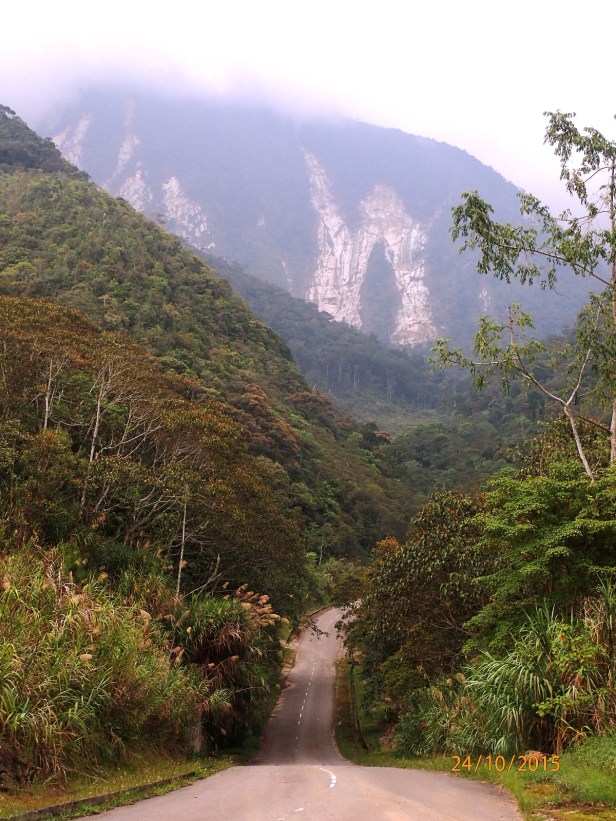
Early morning view of the Eastern shoulder of Kinabalu from the Kinabalu Park buildings at Mesilau before the 2015 earthquake.Early morning, close up view of the Eastern shoulder of Kinabalu from the Kinabalu Park buildings at Mesilau before the 2015 earthquake.The access road to Mesilau after the earthquake showing extensive landslides. The road was badly damaged higher up and the Kinabalu Park Mesilau offices are no longer accesssible.A view of the Mesilau River from above. Ficus cereicarpa and Ficus virescens are both locally common along this river.
The Mesilau River runs just to the right of the Golf Club label on the Google Map below;