



SMOOTH FIG Ficus laevis Blume (1825) SECTION: KISSOSYCEAE
Latin: Smooth referring to the surface of the fig fruit.
Habit: Root climbing vine which grows up tree trunks with the leaves in spirals. The leaves have very long petioles (leaf stalks) which is unusual for root climbing figs.
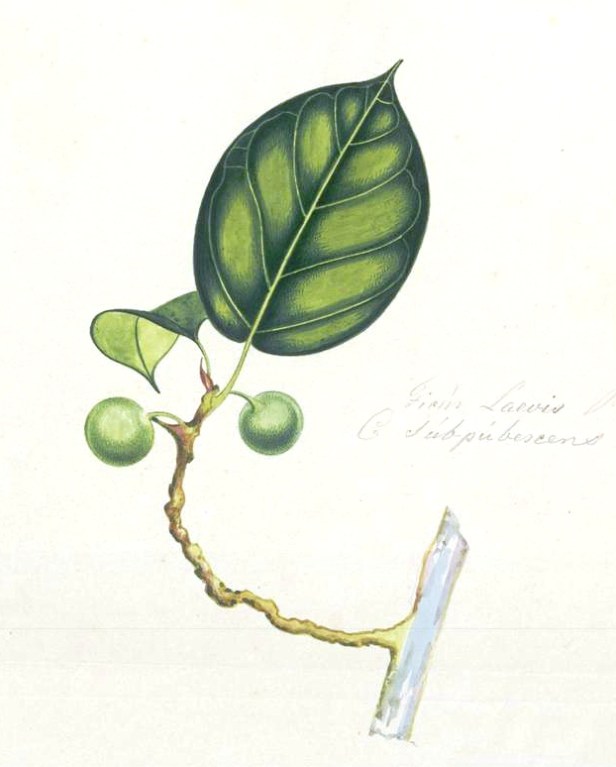
Leaves: The heart shaped leaves with long petioles (stalks) have been mistaken for those of Ficus variegata. However the undersurface of the leaf is strongly patterned in tiles (tessellated). See below.
Figs: The large figs (2-3.5cm) with a long stalk (peduncle) up to 3cm long ripen green/yellow green and likely evolved for bat dispersal.
Sex: Dioecious
Similar species: (1) Herbarium collections without a description of the plant have been confused with Ficus variegata as both the leaves and figs are so similar. Distinguish by growth habit. F. laevis is a root climbing liana with roots at each node whereas F. variegata is a tree. Ficus variegata, Police HQ, Kota Kinabalu, Sabah
(2) Herbarium specimens can also be confused with F. apiocarpa as the position of the leaves, the length of the petiole and the shape and venation of the leaf are so similar (Berg 2005). They can be told apart because F. laevis has a pair of dark waxy glands on the twig below the leaf scars.


Distinguish from F. allutacea by the pattern of the basal veins which are are triple nerved in F. laevis with 3 equally strong veins but in F. allutacea the paired basal veins are no bigger than the other side veins.
Note however that juvenile leaves of F. laevis are not triple nerved, so only compare the undersurface of adult leaves of Ficus laevis with Ficus allutaceae.
Distribution: Common on the Asian continent and in Java and Sumatra but a true mystery fig in Borneo where it is uncommon but very widespread in all habitats. The distribution is possibly relict the result of a dryer climate in Borneo in the past during the Pleistocene glaciations.
Sabah: Beluran in logged forest, Crocker Range in wet virgin forest, Tawau Hills on set aside oil palm.
Sarawak (1) Gunung Subis at Niah (2) Kelabit Highlands Bario (next to air strip).
Kalimantan: Bandjarmasin, Kota Waringin in peat swamp forest, Meratus mountains.
Range: A common native climber throughout the drier areas of India, Thailand, and Vietnam. Uncommon in the Malay Peninsula but common in Sumatra and very common in Java. In Singapore recorded as critically endangered (Chong et al 2009).


Back to THE FIGS of BORNEO