The magnificent fig trees of Tanjung Aru beach, Kota Kinabalu, Sabah
uluulublog
ABOVE: An aerial view of Tanjung Aru beach, a public park in Kota Kinabalu, Sabah, Malaysian Borneo. This park is host to some magnificent large fig trees.
Ficus microcarpa, the most common fig tree at Tg Aru beach. Numerous fine examples grow within the park, both as stand alone banyan figs with stilt roots and as epiphytes or hemi-epiphytes in the casuarina forest along the beach.
Many locals believe that the numerous banyan roots of Ficus microcarpa host spirits or ghosts known as datuks. These datuks can be both benevolent or vindictive depending on how they are treated. Fear of spirits protects these fig trees from being damaged. The red shrine is an attempt to gain the favour of the spirits for help with high risk business ventures or when intending to gamble.
Sabah is located just below the typhoon belt which runs through the Philippines north of Sabah. Hence the local name for Sabah- Negeri di Bawah Bayu or Land Below the Wind. However every ten years or so, the tail end of a Filipino typhoon topples numerous trees along the beach. The first to fall are the top heavy Casuarina equisetiflolia trees ( Pokok Aru) carrying epiphytic Ficus microcarpa fig trees. Typhoon Greg on 26 December 1996 and Typhoon Ondoy (Ketsana) on 26 September 2011 felled many trees at Tg Aru beach.Ficus caulocarpa . There are several magnificent examples growing in the car park next to Prince Philip Park at Tanjung Aru beach.
A young Ficus drupacea fig growing on the small beach between the Shangri-la Tanjung Aru Resort and and water village of Kampung Tanjung Aru. Ficus drupacea is one of the most common stranglers in the secondary forest surrounding Kota Kinabalu and is particularly common at Tg Aru beach..Saplings of Ficus drupacea (left) and Ficus microcarpa (right) growing together on an old Casuarina tree stump at Tg Aru beach.There are 3 pigeons of two species in this photo feeding on ripening Ficus drupacea figs. The numerous fruiting fig trees at Tg Aru beach are the primary reason that the beach is regarded as one of the best bird watching sites in Borneo
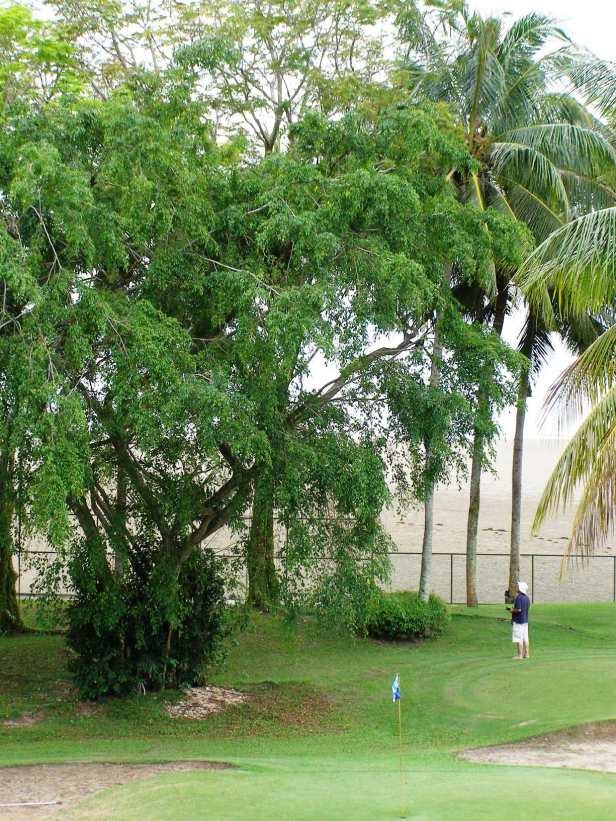
Ficus benjamina , the Weeping Fig (Local name: Waringin) grows wild in the forests of Borneo and ornamental imported varieties are also often cultivated in towns and parks. Waringin are common at Tg Aru beach. This particular individual was growing next to the mini golf course at the Shangri-la Tg Aru Resort.
Ficus racemosa , the Red River Fig (Local name: Tangkol) growing in the car park of the Shangri-la Tanjung Aru resort. This is Borneo’s most revered fig, providing life to many rivers in Borneo and a cultural icon (known as Nunuk Ragang) of the Kadazan-Dusun community in Sabah.
Ficus lyrata. An ornamental fig originating in West Africa frequently planted for landscaping in Borneo. There are several small trees growing on Third Beach next to the airport runway.
The large green figs of Ficus lyrata are always sterile as their pollinating fig wasps are not present in Borneo.
Ficus tinctoria var gibbosa is one of the most common figs around Kota Kinabalu and along Tg Aru beach. However it is rarely noticed as it usually grows as a small epiphytic shrub high up in a host tree.
The Malay name Tanjung Aru translates into Cape of the Casuarina trees . The whole 3 km shore of Tg Aru beach is lined with a belt of shady Casuarina equisetifolia trees with needle like leaves that sigh in the afternoon breeze. The Aru trees provide welcome shade to the many human visitors and nesting holes for many rare birds including Pied Hornbills, Blue-naped Parrots and Rollers.
Tanjung Aru beach faces the west. Every evening at sundown hundreds of tourists from mainland China visit the beach to enjoy the sunset. As the sun sinks into the South China Sea, the glowing sky silhouettes the islands of the Tunku Abdul Rahman Park. Pulau Sulug on the left, Pulau Mamutik backed by Pulau Manukan on the right.